Hard water is a common challenge for commercial establishments that depend on a consistent water supply for daily operations. In Meerut, hotels, hospitals, restaurants, laundries, schools, manufacturing units, and commercial buildings may experience problems caused by high calcium and magnesium levels in water. These minerals can lead to scale formation in pipelines, boilers, heat exchangers, washing machines, and other equipment. Choosing the right water softener plant capacity for commercial use in Meerut is essential to control these issues, improve operational efficiency, and reduce maintenance requirements.
3D Aqua provides water treatment solutions designed around water quality, daily consumption, and specific commercial requirements. Our team helps businesses identify a suitable water softener system based on water hardness, peak demand, operating hours, and installation conditions. Whether you need a compact unit for a small commercial facility or a higher-capacity system for an industrial application, selecting the correct capacity is the first step towards reliable water treatment.
Get FREE Water Testing & Best Price Quote in Meerut.
📞 Call / WhatsApp: 6262629090
🌐 Website: https://www.3daqua.in/
Why Is Choosing the Right Water Softener Plant Capacity Important?
Commercial facilities require different quantities of softened water depending on their operations. Installing an undersized water softener can result in insufficient treated water, frequent regeneration, and interruptions during peak usage. On the other hand, an oversized system may increase the initial investment and occupy unnecessary space.
The right capacity helps businesses maintain a consistent supply of softened water while managing water consumption, salt usage, and operating costs.
Common Problems Caused by Hard Water
- Scale formation: Calcium and magnesium deposits accumulate inside pipes, boilers, and heating equipment.
- Higher maintenance costs: Scale buildup can increase cleaning frequency and equipment servicing requirements.
- Reduced equipment efficiency: Deposits on heat-transfer surfaces can interfere with efficient heating.
- Laundry problems: Hard water can reduce detergent effectiveness and contribute to mineral deposits on fabrics.
- Cleaning difficulties: Mineral spots and residue may appear on glassware, bathroom fixtures, and other surfaces.
- Inconsistent water quality: Commercial operations may struggle to maintain suitable water quality across different applications.
A properly sized water softener plant helps reduce hardness-related problems. However, it does not remove every type of contaminant, such as dissolved salts, bacteria, or all organic impurities. Additional treatment may be necessary depending on the water quality and intended application.
How to Calculate Water Softener Plant Capacity for Commercial Use
Selecting a water softener plant requires more than estimating the daily water requirement. The system must also account for raw water hardness, peak flow, regeneration frequency, and the volume of water required between regeneration cycles.
1. Calculate Daily Water Consumption
First, estimate how much water your business uses daily. Consider the number of occupants, production requirements, equipment consumption, and operating hours.
For example:
- A small restaurant may require a relatively compact system.
- A hotel may need a higher capacity because of guest rooms, laundry, kitchens, and housekeeping.
- A hospital may require carefully planned treatment for laundry, utility water, and other suitable applications.
- A manufacturing unit may need a system designed around process demand and equipment requirements.
These are examples only. Actual capacity must be determined from measured consumption and operating conditions.
2. Check Raw Water Hardness
Water hardness is commonly measured in parts per million (ppm) or milligrams per litre (mg/L), generally expressed as calcium carbonate equivalent.
Higher hardness means the softener must remove a greater quantity of hardness minerals for the same volume of water. Therefore, two businesses consuming equal amounts of water may require different softener capacities.
Free water testing is a useful starting point for determining the appropriate treatment requirements.
3. Determine the Required Flow Rate
Flow rate indicates how much softened water the system must deliver per hour, usually measured in litres per hour (LPH) or cubic metres per hour (m³/h).
A commercial building with several outlets operating simultaneously may need a higher instantaneous flow rate than a facility with evenly distributed water consumption.
4. Consider Regeneration Requirements
Most conventional commercial water softeners use ion-exchange resin to remove hardness minerals. The resin eventually requires regeneration using a suitable salt solution.
The system should be designed to provide enough soft water between regeneration cycles. Resin quantity, water hardness, operating demand, salt consumption, and the available regeneration window all influence the final design.
Get expert assistance before selecting a plant based only on daily water consumption.
📞 Call / WhatsApp: 6262629090
Get FREE Water Testing & Best Price Quote in Meerut.
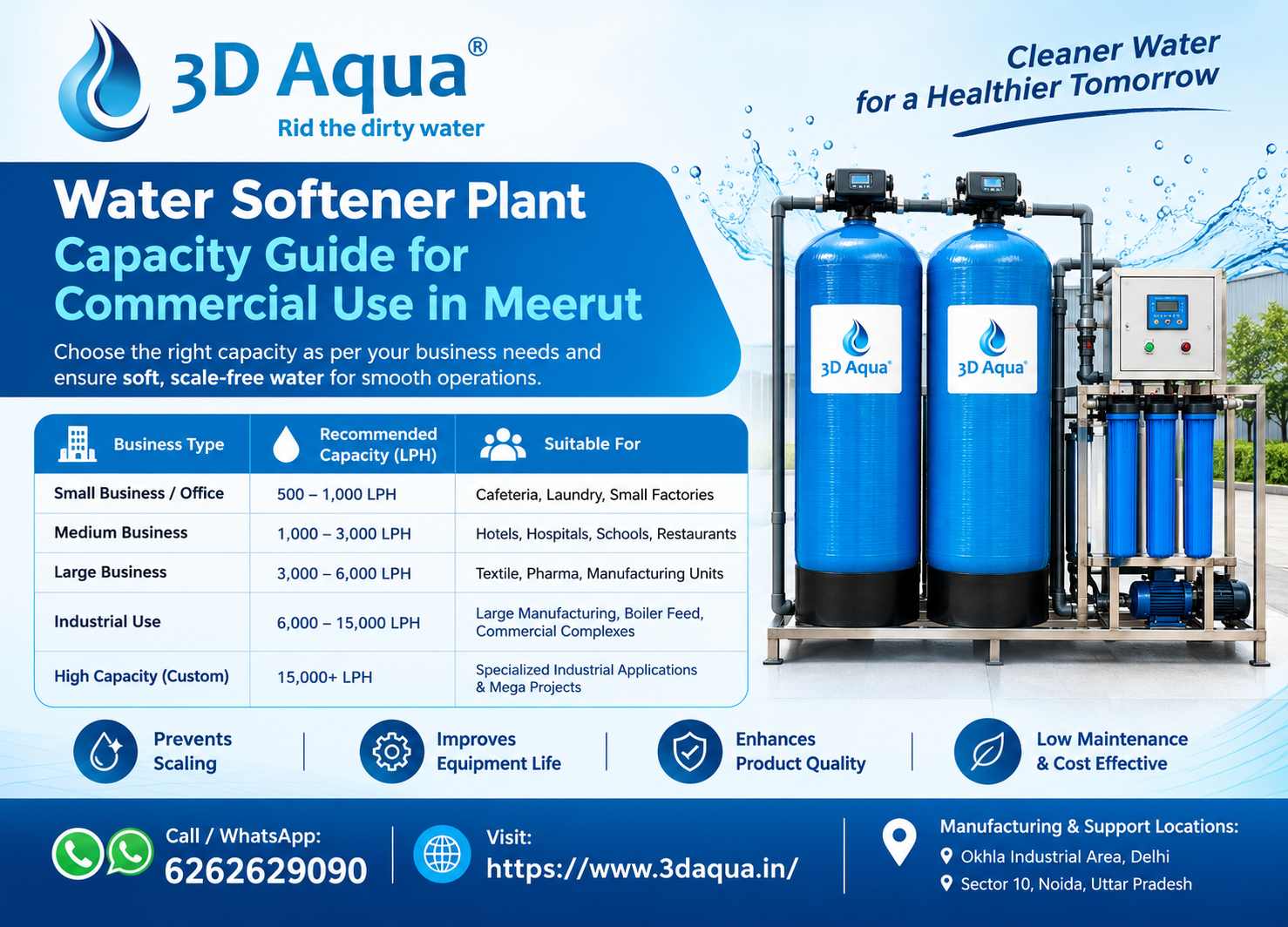
Commercial Water Softener Plant Capacity Guide
The following table provides indicative capacity ranges to help businesses begin planning. These ranges are not final equipment specifications; actual selection depends on water analysis, peak demand, hardness-removal requirements, and regeneration arrangements.
| Commercial application | Indicative soft water demand | Capacity planning |
|---|---|---|
| Small office or shop | 1,000–3,000 litres/day | Compact commercial unit |
| Restaurant or small commercial kitchen | 2,000–5,000 litres/day | Small to medium unit |
| School or medium office | 3,000–10,000 litres/day | Medium commercial unit |
| Hotel or guest house | 5,000–25,000 litres/day | Medium to large unit |
| Hospital or large laundry | 10,000–50,000 litres/day | High-demand system |
| Industrial or large commercial facility | 25,000 litres/day and above | Site-specific engineered system |
Note: These are illustrative daily-demand bands, not guaranteed plant capacities. A final recommendation should include the required service flow, hardness-removal capacity, resin volume, and regeneration schedule.
Example of Capacity Calculation
Suppose a commercial facility in Meerut requires 10,000 litres of softened water daily. Its raw water hardness is measured at 300 mg/L as CaCO₃.
The approximate daily hardness load is:
10,000 L/day × 300 mg/L = 3,000,000 mg/day
This equals approximately 3 kg of hardness as CaCO₃ per day.
The softener must be designed to handle this hardness load while meeting the required flow rate and regeneration schedule. The final resin quantity cannot be calculated accurately from daily consumption alone; the resin’s working capacity and the intended operating cycle must also be considered.
Types of Commercial Water Softener Plants
Different commercial applications may require different system configurations.
1. Single-Tank Water Softener
A single-tank system is suitable for many small and medium commercial applications where temporary interruptions during regeneration can be accommodated. It is generally simpler to install and operate.
2. Automatic Water Softener Plant
An automatic softener uses a control valve to manage service and regeneration cycles. Depending on the configuration, it can reduce the need for manual operation and support consistent routine maintenance.
3. Twin-Tank Water Softener
Twin-tank systems are useful where a continuous supply of softened water is important. One tank can remain in service while the other regenerates, subject to the system’s design and operating sequence.
4. Industrial Water Softener Plant
Industrial systems are designed for larger flow rates and greater hardness loads. They may be used in manufacturing facilities, hotels, laundries, boiler-feed pretreatment, and other applications where properly softened water is required.
5. Customized Water Softener System
A customized system is planned according to site conditions, raw water quality, demand patterns, and the required treatment process. Additional filtration or other treatment stages may be recommended where necessary.
Water Softener Plant Price in Meerut
The price of a commercial water softener plant depends on its capacity, resin volume, control valve, tank material, automation level, installation requirements, and pretreatment needs.
The following are broad indicative budgeting ranges in Indian rupees, not verified current quotations. Actual prices may differ considerably by specification and supplier.
| System category | Indicative budget range |
|---|---|
| Small commercial unit | ₹25,000–₹60,000 |
| Medium commercial unit | ₹60,000–₹1,50,000 |
| Large commercial unit | ₹1,50,000–₹4,00,000 |
| Industrial or customized system | ₹4,00,000 onwards |
Prices may exclude GST, transportation, installation, additional filtration, civil work, and other site-specific requirements. Confirm the complete scope before comparing quotations.
To receive an accurate quotation for a water softener plant in Meerut, share your daily water consumption, raw water hardness report if available, required flow rate, and intended application with the 3D Aqua team.
Why Choose 3D Aqua for Water Softener Plants in Meerut?
Choosing a water treatment supplier involves more than comparing equipment prices. The system should be suitable for your water quality, operational needs, and long-term maintenance requirements.
Site Inspection Before Quotation
Our team can assess your application, available installation space, water supply arrangements, and operating requirements before recommending a suitable solution. Site inspection availability and scope can be confirmed when scheduling your enquiry.
Customized Capacity-Based Solutions
3D Aqua focuses on matching water treatment recommendations to the required flow rate, hardness load, and commercial usage. This helps avoid selecting a system based only on an estimated daily water requirement.
After-Sales Support and Maintenance
Regular inspection, resin performance checks, salt management, control valve servicing, and monitoring of treated water quality help maintain system performance. Maintenance requirements vary by installation and operating conditions.
Commercial and Industrial Applications
Water softening solutions can support suitable applications in hotels, restaurants, offices, hospitals, laundries, and manufacturing facilities across Meerut and surrounding areas.
Experienced Water Treatment Support
3D Aqua offers water treatment solutions through its manufacturing and support network in Okhla Industrial Area, Delhi, and Sector 10, Noida, Uttar Pradesh. Contact our team to discuss your site requirements and confirm service availability in Meerut.
Frequently Asked Questions (FAQs)
1. Which water softener plant capacity is suitable for a hotel in Meerut?
The capacity depends on the number of rooms, occupancy, laundry demand, kitchen usage, and water hardness. A water consumption assessment and hardness test are recommended before selecting the system.
2. How do I calculate the capacity of a commercial water softener?
Start with daily water consumption, raw water hardness, required service flow rate, and the desired time between regeneration cycles. These details help determine the resin quantity and equipment configuration.
3. What is the price of a commercial water softener plant in Meerut?
A small commercial system may have a lower initial cost than a large industrial plant. The final price depends on capacity, automation, resin, pretreatment, installation, and other specifications. Request a customized quotation for an accurate estimate.
4. Does a water softener remove TDS from water?
A conventional ion-exchange water softener primarily removes calcium and magnesium hardness. It generally does not reduce total dissolved solids (TDS) in the same way as a reverse osmosis system. Additional treatment may be needed depending on the application.
5. How often does a commercial water softener need maintenance?
Maintenance frequency depends on water quality, water consumption, salt usage, resin condition, and control valve settings. Routine inspections and monitoring of outlet hardness help identify when servicing is required.
Still confused about the right capacity?
📞 Call / WhatsApp: 6262629090 for expert guidance.
Get the Best Water Softener Plant in Meerut
Facing hard water problems in your commercial building, hotel, restaurant, laundry, or industrial unit? Don’t wait for scale buildup to increase your maintenance burden.
Choose a suitable commercial water softener plant in Meerut with guidance from 3D Aqua.
📞 Call / WhatsApp: 6262629090
🌐 Visit: https://www.3daqua.in/
Fill in the enquiry form below for:
- Free consultation
- Best price quotation
- Site inspection, subject to scheduling and service availability
Contact Details – 3D Aqua
Manufacturing & Support:
- Okhla Industrial Area, Delhi
- Sector 10, Noida, Uttar Pradesh
Contact Us: 0120-4153030 | 7011143366 | 6262629090
24/7 Helpline: +91 8963089630
Email: info@3daqua.in
Learn More:
- Website: https://www.3daqua.in/
- Explore Softener Products: https://www.3daqua.in/products
- Happy Clients: https://3daqua.in/clients
Contact 3D Aqua today to discuss your water quality, capacity requirements, and commercial water softening needs in Meerut.