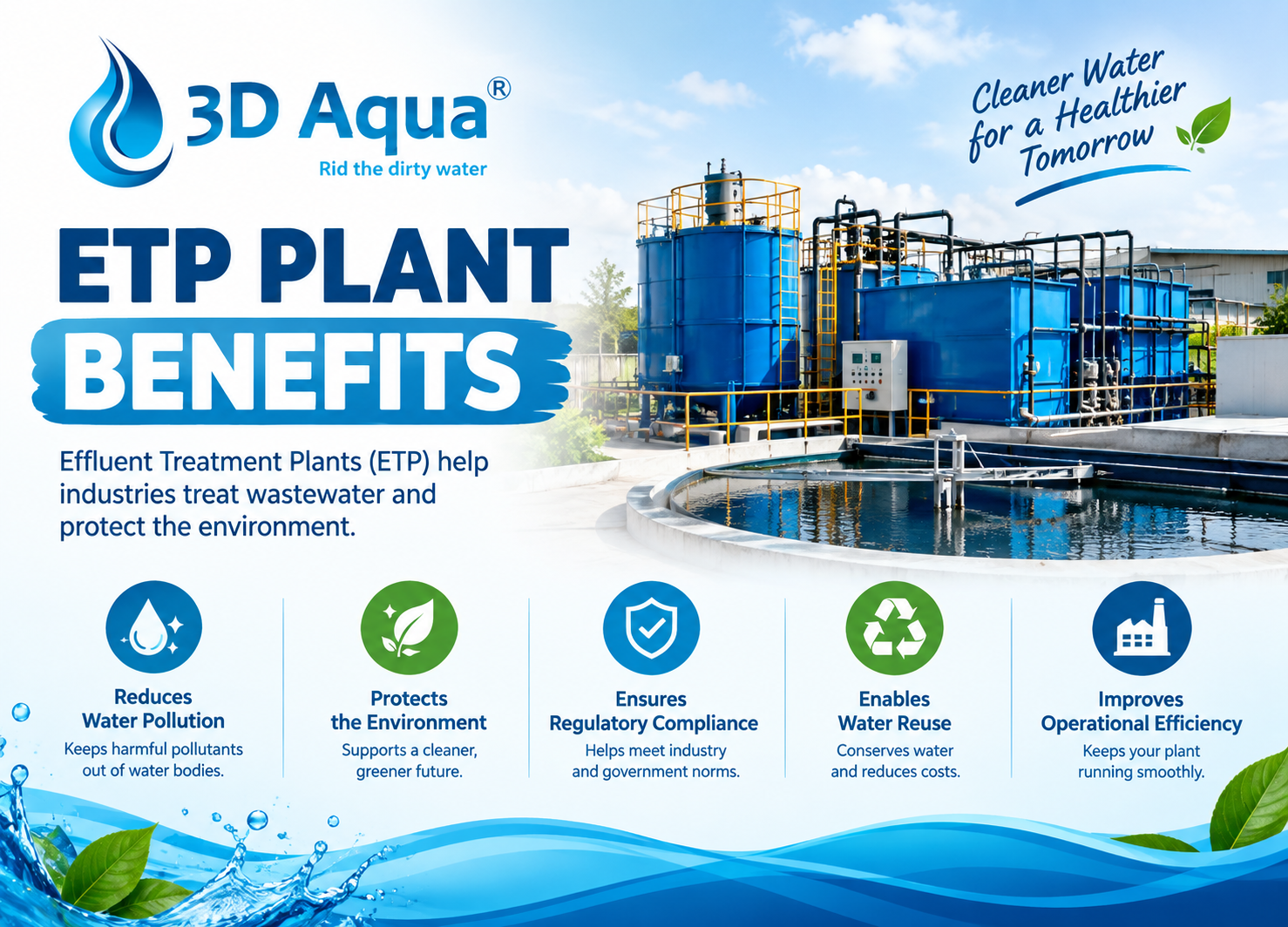
Industries generate large amounts of wastewater during manufacturing, processing, cleaning, and other industrial operations. This wastewater often contains harmful chemicals, oils, suspended solids, heavy metals, and other pollutants that can damage the environment if discharged without proper treatment. An Effluent Treatment Plant (ETP) provides an effective solution by treating industrial wastewater and making it suitable for safe discharge or reuse, depending on the required treatment standards. Businesses in Delhi, Noida, Faridabad, Ghaziabad, and other industrial areas need reliable wastewater management systems to meet pollution control requirements. 3D Aqua offers customized ETP plant solutions designed according to industrial wastewater quality, capacity, and treatment requirements, helping industries improve water management and environmental performance.
📞 Call / WhatsApp: 6262629090
Get FREE Water Testing & Best Price Quote for ETP Plant Installation.
What Is an ETP Plant and Why Is It Important?
An Effluent Treatment Plant (ETP) is a wastewater treatment system designed to remove pollutants from industrial wastewater before it is discharged or reused. Different industries generate different types of effluents, so the treatment process depends on the wastewater’s chemical composition and contamination level.
Industries such as pharmaceuticals, textiles, food processing, chemicals, automobile manufacturing, and engineering units require effective wastewater treatment systems.
Without proper treatment, industrial wastewater can create several problems:
- Water Pollution: Untreated effluent can contaminate rivers, lakes, groundwater, and other water sources.
- Environmental Damage: Harmful chemicals and pollutants can affect aquatic life and ecosystems.
- Regulatory Issues: Industries may face penalties or operational restrictions for non-compliance with applicable pollution control requirements.
- Health Risks: Contaminated water can create risks for workers and nearby communities.
- Increased Operating Costs: Poor wastewater management can increase water consumption and disposal expenses.
Installing an efficient ETP plant helps industries manage these challenges while supporting responsible industrial operations.
Major Benefits of an ETP Plant for Industries
An ETP plant provides several environmental, operational, and financial advantages. Some of its most important benefits are explained below.
1. Reduces Water Pollution
One of the biggest benefits of an ETP plant is the reduction of harmful pollutants in industrial wastewater. It removes suspended solids, oils, grease, organic matter, and other contaminants through suitable treatment processes.
This helps reduce the environmental impact of industrial discharge.
2. Helps Meet Pollution Control Standards
Industries must follow applicable wastewater discharge standards and pollution control guidelines. An appropriately designed and operated ETP plant helps businesses meet the required treatment parameters.
Regular testing and monitoring are important to maintain compliance with the applicable CPCB and State Pollution Control Board requirements.
3. Supports Water Recycling and Reuse
Water conservation is becoming increasingly important for industries. An ETP plant can help recover treated wastewater for suitable non-potable applications, depending on the treatment quality and reuse requirements.
Recycled water may be used for:
- Gardening and landscaping.
- Floor and equipment washing.
- Cooling tower makeup.
- Certain industrial processes.
- Other approved non-potable applications.
This reduces dependence on freshwater sources and supports sustainable water management.
4. Reduces Wastewater Disposal Costs
Industries generating large volumes of wastewater may face high disposal and water management expenses. An efficient ETP system can help reduce these costs by treating wastewater at the source and enabling suitable reuse.
Over time, effective wastewater management can improve operational efficiency and resource utilization.
5. Protects the Environment
Industrial wastewater may contain toxic substances, chemicals, and other harmful pollutants. Treating wastewater before discharge helps protect natural water bodies, soil quality, and aquatic ecosystems.
An ETP plant supports environmentally responsible manufacturing and sustainable industrial development.
6. Improves Industrial Productivity
A properly designed wastewater treatment system helps industries manage effluent consistently. Automated monitoring, suitable treatment equipment, and regular maintenance can improve operational reliability and reduce unexpected treatment interruptions.
7. Builds Business Reputation
Companies that follow responsible environmental practices demonstrate their commitment to sustainability. Effective wastewater management can strengthen customer confidence, support environmental reporting, and improve a company’s overall reputation.
How Does an ETP Plant Work?
An ETP plant uses multiple treatment stages to remove different types of contaminants from industrial wastewater.
The main treatment stages generally include:
1. Preliminary Treatment: Screens and collection systems remove larger particles and unwanted materials from wastewater.
2. Oil and Grease Removal: Suitable separation systems remove floating oil, grease, and similar substances.
3. Primary Treatment: Coagulation, flocculation, and sedimentation help remove suspended solids and other settleable pollutants.
4. Biological Treatment: Biological processes use microorganisms to break down biodegradable organic matter.
5. Secondary Clarification: Suspended biological solids are separated from treated wastewater.
6. Tertiary Treatment: Filtration, activated carbon, disinfection, or other advanced processes improve the treated water quality according to its intended use.
7. Sludge Management: Sludge generated during treatment is collected, dewatered, and managed according to applicable disposal requirements.
The exact treatment process depends on wastewater characteristics, industry type, required output quality, and discharge or reuse standards.
Customized ETP Plant Solutions for Different Industries
Different industries require different wastewater treatment technologies. 3D Aqua provides ETP solutions designed around individual industrial requirements.
Common applications include:
- Textile Industry: Treatment of wastewater containing dyes, chemicals, and suspended solids.
- Pharmaceutical Industry: Treatment of complex wastewater containing organic and chemical pollutants.
- Food Processing Industry: Treatment of wastewater containing oils, fats, organic matter, and food residues.
- Chemical Industry: Treatment of wastewater containing chemicals and industry-specific contaminants.
- Automobile Industry: Treatment of wastewater containing oils, grease, and industrial cleaning chemicals.
- Manufacturing Units: Customized treatment systems for process wastewater and equipment cleaning effluent.
Get Expert ETP Plant Consultation
Looking for an efficient ETP plant for your industry?
3D Aqua provides customized wastewater treatment solutions based on water testing, industrial requirements, and treatment capacity.
📞 Call / WhatsApp: 6262629090
Get FREE Water Testing & Best Price Quote.
Types of ETP Plants Available
ETP plants are available in different configurations depending on wastewater characteristics, treatment requirements, available space, and industrial capacity.
| ETP Plant Type | Application |
|---|---|
| Conventional ETP | General industrial wastewater treatment |
| Chemical ETP | Wastewater containing chemicals and suspended pollutants |
| Biological ETP | Wastewater containing biodegradable organic matter |
| MBBR-Based ETP | Biological treatment using moving biofilm carriers |
| SBR-Based ETP | Batch-based biological wastewater treatment |
| MBR-Based ETP | Advanced biological treatment with membrane filtration |
| Compact ETP | Industries with limited installation space |
| Customized ETP | Specialized industrial wastewater requirements |
The most suitable technology should be selected after evaluating wastewater test results and the required treated water quality.
ETP Plant Price and Installation Cost
The cost of an ETP plant depends on several factors, including treatment capacity, wastewater characteristics, technology, equipment quality, automation, and installation requirements.
Below is an indicative cost range for initial budgeting. Actual quotations may vary depending on project specifications.
| ETP Capacity | Indicative Price Range |
|---|---|
| 5 KLD | ₹3–6 Lakh |
| 10 KLD | ₹5–9 Lakh |
| 25 KLD | ₹8–15 Lakh |
| 50 KLD | ₹12–25 Lakh |
| 100 KLD | ₹20–40 Lakh |
| 200 KLD | ₹35–65 Lakh |
| 500 KLD | ₹65 Lakh–₹1.2 Crore |
Note: These are indicative budget estimates, not fixed market quotations. Civil construction, piping, electrical work, advanced treatment equipment, sludge handling, and site-specific requirements may affect the final project cost.
Factors Affecting ETP Plant Cost
- Daily wastewater treatment capacity (KLD).
- Type and concentration of pollutants.
- Selection of treatment technology.
- Quality and material of equipment.
- Level of automation and monitoring.
- Civil work and available installation space.
- Operation and maintenance requirements.
For an accurate quotation, wastewater testing and site evaluation are recommended.
Why Choose 3D Aqua for ETP Plant Solutions?
Choosing the right ETP manufacturer is important for reliable wastewater treatment and long-term plant performance.
3D Aqua provides industrial water and wastewater treatment solutions for businesses across Delhi, Noida, Faridabad, Ghaziabad, and other locations.
1. Site Inspection Before Quotation
Our team considers site conditions, available space, wastewater generation, and installation requirements before preparing a project quotation.
2. Customized Capacity-Based Solutions
We design ETP plants according to the industry’s wastewater characteristics and daily treatment capacity, helping businesses select suitable treatment technologies.
3. Quality Equipment and Engineering
We focus on suitable equipment selection, practical system design, and efficient treatment processes for industrial applications.
4. After-Sales Support and Maintenance
Regular maintenance is important for consistent ETP performance. We provide support for plant maintenance, troubleshooting, and operational requirements.
5. Industrial Water Treatment Experience
Our solutions cover ETP, STP, WTP, RO plants, UF systems, and water softeners for different commercial and industrial applications.
Manufacturing & Support Locations:
- Okhla Industrial Area, Delhi
- Sector 10, Noida, Uttar Pradesh
Frequently Asked Questions (FAQs)
1. What is the main benefit of an ETP plant?
The main benefit of an ETP plant is that it treats industrial wastewater by removing harmful pollutants, helping protect the environment and supporting compliance with applicable wastewater discharge standards.
2. Which industries need an ETP plant?
Industries such as textiles, pharmaceuticals, chemicals, food processing, automobile manufacturing, engineering, and other manufacturing sectors may require ETP plants depending on their wastewater generation and applicable regulations.
3. Can treated ETP water be reused?
Yes. Treated wastewater can be reused for suitable non-potable applications such as gardening, floor washing, cooling tower makeup, and certain industrial processes, provided it meets the required quality standards.
4. What is the cost of an ETP plant?
ETP plant prices depend on capacity, technology, wastewater characteristics, equipment, and installation requirements. A site inspection and wastewater analysis help determine the actual project cost.
5. How often does an ETP plant require maintenance?
ETP plants require regular maintenance. Daily operational checks, periodic equipment servicing, sludge management, filter cleaning, and water quality testing help maintain efficient performance. The maintenance schedule depends on plant design and operating conditions.
Still confused?
📞 Call / WhatsApp: 6262629090 for expert guidance.
Get the Best ETP Plant Solution for Your Industry
Facing industrial wastewater treatment challenges? Don’t wait. Choose a reliable and customized ETP plant solution from 3D Aqua to improve wastewater management, support environmental compliance, and make better use of water resources.
📞 Call / WhatsApp: 6262629090
🌐 Visit: https://www.3daqua.in/
👇 Fill out the enquiry form below for:
✔ Free Consultation
✔ Best Price Quotation
✔ Site Inspection
Contact Details – 3D Aqua
Manufacturing & Support:
- Okhla Industrial Area, Delhi
- Sector 10, Noida, Uttar Pradesh
Contact Us:
0120-4153030 | 7011143366 | 6262629090
24/7 Helpline: +91 8963089630
Email: info@3daqua.in
Learn More:
- Website: https://www.3daqua.in/
- Explore Softener Products: https://www.3daqua.in/products
- Happy Clients: https://3daqua.in/clients
3D Aqua – Complete Industrial Water & Wastewater Treatment Solutions.