In today’s environmentally conscious era, wastewater management has become one of the most critical responsibilities of industries across sectors. Whether you’re in manufacturing, food processing, pharma, or textiles, treating your wastewater efficiently is not just a regulatory requirement — it’s a commitment to sustainability.
This is where Effluent Treatment Plants (ETPs) come in. But with multiple technologies, capacities, and compliance factors involved, selecting the right ETP can be confusing. This guide simplifies that decision-making process.
For more information, call us at: 6262629090
Visit our website: www.3daqua.in
What is an ETP Plant?
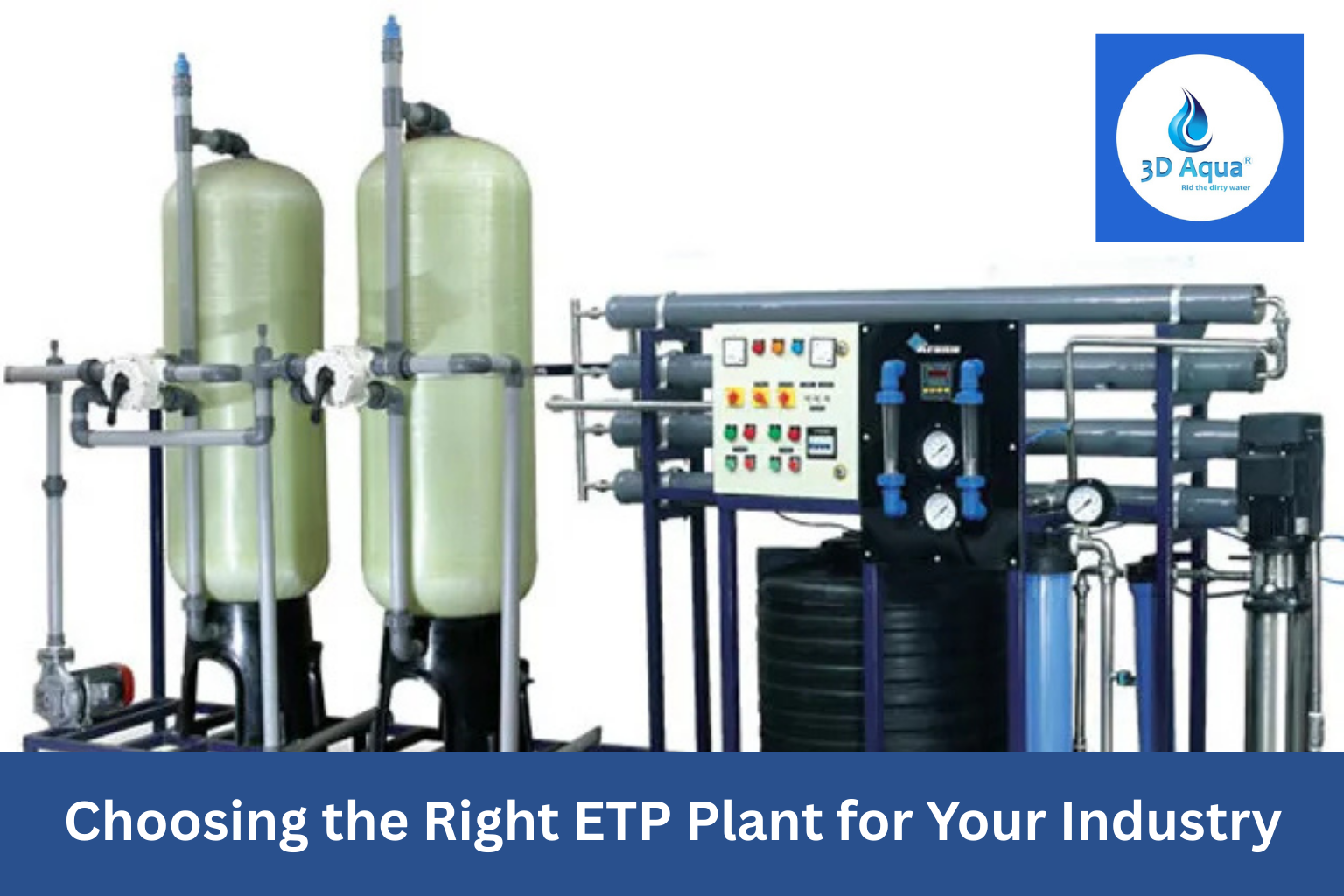
An Effluent Treatment Plant (ETP) is a wastewater treatment system designed to treat industrial effluents before they are discharged into municipal sewers or the environment.
Unlike common wastewater, industrial effluent often contains:
- Toxic chemicals
- Heavy metals
- High BOD/COD
- Suspended solids
- Specific industry by-products
An effective ETP ensures treated water meets environmental norms set by pollution control boards — protecting both public health and your business credibility.
Why Choosing the Right ETP Matters
A poorly chosen ETP system can lead to:
✔ Regulatory fines
✔ Non-compliance notices
✔ Frequent breakdowns
✔ High operating costs
✔ Environmental damage
On the other hand, a well-matched ETP:
✔ Ensures compliance with CPCB/SPCB standards
✔ Reduces operational costs
✔ Enables water reuse and recycling
✔ Improves longevity of equipment
✔ Enhances corporate environmental responsibility
For more information, call us at: 6262629090
Visit our website: www.3daqua.in
Key Factors to Consider When Choosing an ETP
1. Understand Your Industry Waste Profile
Every industry generates a unique wastewater composition. Before choosing an ETP, identify:
- Type of pollutants
- pH range
- BOD and COD levels
- Oil & grease content
- Heavy metals and toxic chemicals
This determines the treatment strategy — physical, chemical, biological or hybrid.
2. Types of ETP Technologies
a. Physical Treatment
Used as a pre-treatment stage to remove solids and suspended particles:
- Screening
- Grit removal
- Sedimentation
b. Chemical Treatment
Neutralizes pH and removes dissolved contaminants:
- Coagulation
- Flocculation
- Chemical dosing
c. Biological Treatment
Ideal for organic effluents (high BOD/COD):
- Activated Sludge Process
- Aerobic & Anaerobic Treatment
- Trickling Filters
d. Advanced Treatment
For stricter discharge standards or reuse:
- Membrane filtration (UF/RO)
- Ion exchange
- Adsorption
The right ETP often combines multiple treatment stages — known as a hybrid system.
3. Plant Capacity & Scalability
ETP capacity is measured in m³/day (kiloliters per day) based on wastewater volume.
Ask:
✔ How much wastewater will be generated daily?
✔ Will your production increase in future?
✔ Do you need room for scalability?
Choosing a plant with future scalability ensures long-term value without frequent upgrades.
4. Compliance with Regulations
In India, ETP design and discharge standards must comply with:
✔ CPCB/SPCB guidelines
✔ Water Act & Environmental norms
Before installation, check:
- Permissible discharge parameters
- Monitoring requirements
- Consent to Establish (CTE) & Consent to Operate (CTO)
Failure to comply can result in legal action and shutdowns.
5. Footprint & Space Availability
Industrial units sometimes overlook site space. Choose an ETP system that fits your available land without compromising efficiency.
Modular designs can help when space is limited.
For more information, call us at: 6262629090
Visit our website: www.3daqua.in
6. Operating Cost & Maintenance
ETP systems differ in:
📌 Energy consumption
📌 Chemical usage
📌 Maintenance frequency
📌 Skilled operator requirements
Ensure you evaluate:
- Lifecycle cost (CAPEX + OPEX)
- Spare parts availability
- Automation and remote monitoring features
Choosing an energy-efficient system saves costs in the long run.
7. Water Reuse & Zero Liquid Discharge (ZLD)
Many industries now aim for water recycling or ZLD systems, especially in water-scarce regions.
Benefits include:
- Minimal freshwater dependency
- Reduced effluent discharge
- Cost savings on water purchases
If reuse is a priority, ensure your ETP is designed with advanced filtration and polishing units.
ETP Selection Checklist
Before finalizing a model or vendor, review this checklist:
🔲 Wastewater analysis report
🔲 Daily wastewater volume
🔲 Applicable discharge standards
🔲 Treatment stages required
🔲 Available plant area
🔲 Budget & operating cost analysis
🔲 Maintenance plan with SLA
🔲 Warranty & after-sales support
🔲 Vendor credibility and certifications
Benefits of a Well-Designed ETP
✅ Meets regulatory compliance
✅ Protects water resources
✅ Saves operational costs
✅ Encourages sustainable operations
✅ Enhances corporate image
✅ Enables water reuse
For more information, call us at: 6262629090
Visit our website: www.3daqua.in
Why Choose 3DAqua for Your ETP Needs?
At 3DAqua, we don’t just supply equipment — we deliver customized wastewater treatment solutions tailored to your industry.
✨ Industry-specific expertise
✨ Robust design & high-efficiency plants
✨ After-sales support & maintenance
✨ Cost-effective and future-ready systems
🏭 Manufacturing & Support:
- Okhla Industrial Area, Delhi
- Sector 10, Noida, Uttar Pradesh
📞 Contact Us:
- 0120-4153030 | 7011143366 | 6262629090
- 24/7 Helpline: +91 8963089630
- Email: info@3daqua.in
🌐 Learn More:
- Website: www.3daqua.in
- Explore Softener Products: www.3daqua.in/products
- Happy Clients: https://3daqua.in/clients