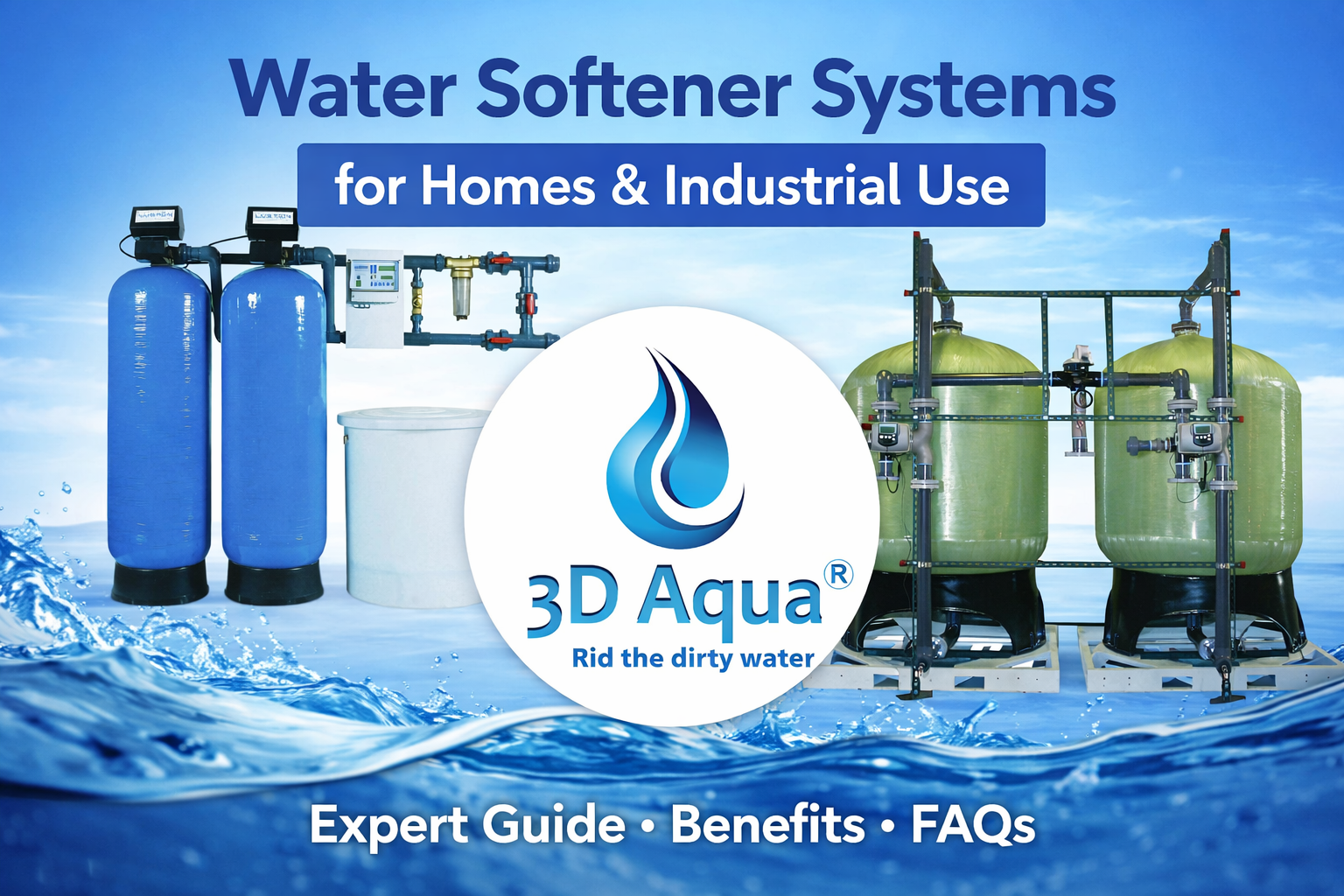
Hard water is a common problem in many parts of India. It contains high levels of calcium and magnesium, which cause scaling in pipes, damage appliances, reduce soap efficiency, and affect industrial machinery.
A water softener system removes hardness minerals and improves water quality for residential and industrial use.
In this guide, we will cover everything you need to know before buying a water softener system.
For more information, call us at: 6262629090
Visit our website: www.3daqua.in
What is a Water Softener System?
A water softener is a filtration system that removes hardness-causing minerals like calcium (Ca) and magnesium (Mg) from water through a process called ion exchange.
It replaces hard minerals with sodium or potassium ions, making the water soft and suitable for daily use.
For more information, call us at: 6262629090
Visit our website: www.3daqua.in
Why Do You Need a Water Softener?
For Homes
- Prevents scale buildup in geysers and pipes
- Increases life of washing machines and dishwashers
- Reduces soap and detergent consumption
- Makes skin and hair softer
- Keeps bathroom fittings stain-free
For Industries
- Protects boilers and cooling towers
- Reduces maintenance costs
- Improves efficiency of RO plants
- Prevents pipeline blockages
- Enhances product quality in manufacturing
Types of Water Softener Systems
1. Salt-Based Water Softener
Most common type. Uses ion exchange resin and salt for regeneration. Highly effective for high hardness water.
2. Salt-Free Water Conditioner
Does not remove hardness but changes mineral structure to prevent scaling. Low maintenance.
3. Dual Tank Water Softener
Ideal for industries and large homes. Provides continuous soft water supply without interruption.
4. Magnetic or Electronic Descaler
Budget-friendly option. Reduces scaling but does not fully soften water.
For more information, call us at: 6262629090
Visit our website: www.3daqua.in
How Does a Water Softener Work?
- Hard water enters the resin tank.
- Resin beads attract calcium and magnesium ions.
- Sodium ions replace hardness minerals.
- Soft water flows into the storage tank.
- During regeneration, salt cleans the resin beads for reuse.
Benefits of Installing a Water Softener
- 40–50% reduction in energy consumption
- Lower plumbing repair costs
- Longer lifespan of appliances
- Better water flow
- Improved cleaning performance
Water Softener Capacity Guide
| Usage Type | Recommended Capacity |
|---|---|
| Small Family (2–4 members) | 10–15 L resin |
| Medium Family (5–8 members) | 15–25 L resin |
| Large Home / Apartment | 25–50 L resin |
| Small Industry | 50–200 L resin |
| Large Industry | 200L+ customized |
Installation & Maintenance
Installation
- Installed at the main water inlet line
- Requires drainage connection
- Should be placed before RO system
Maintenance
- Salt refill every 15–30 days
- Resin replacement every 3–5 years
- Regular system inspection
Water Softener Cost in India
- Home Systems: ₹15,000 – ₹45,000
- Industrial Systems: ₹50,000 – ₹5,00,000+ (depends on capacity and automation)
For more information, call us at: 6262629090
Visit our website: www.3daqua.in
How to Choose the Right Water Softener?
✔ Check water hardness level (TDS test)
✔ Calculate daily water consumption
✔ Choose automatic or manual system
✔ Consider space and installation area
✔ Compare warranty and service support
Contact 3D Aqua today
Manufacturing & Support:
- Okhla Industrial Area, Delhi
- Sector 10, Noida, Uttar Pradesh
Contact Us:
- 0120-4153030 | 7011143366 | 6262629090
- 24/7 Helpline: +91 8963089630
- Email: info@3daqua.in
Learn More:
- Website: www.3daqua.in
- Explore Softener Products: www.3daqua.in/products
- Happy Clients:https://3daqua.in/clients
Conclusion
Investing in a water softener system is a smart decision for both residential and industrial applications. It protects plumbing systems, reduces maintenance costs, and ensures long-term savings.
Before purchasing, always test your water quality and consult a professional supplier for the right capacity and model.