
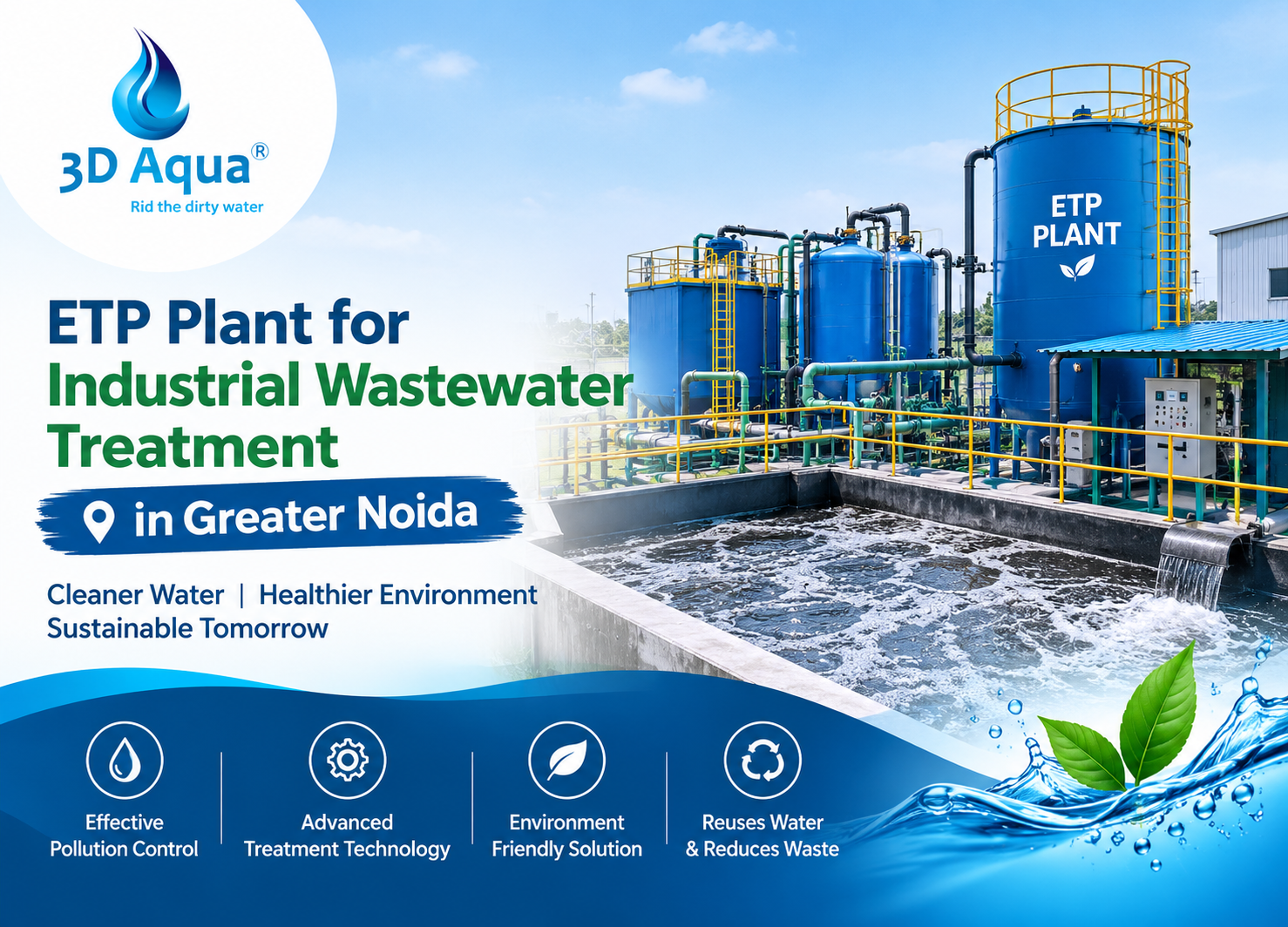
Industrial wastewater management is a major concern for manufacturing units, factories, pharmaceutical companies, textile industries, food processing plants, and other industrial facilities in Greater Noida. Untreated industrial wastewater may contain chemicals, oils, suspended solids, heavy metals, and other pollutants that can harm the environment and affect water quality. An efficient Effluent Treatment Plant (ETP) helps industries treat wastewater before its safe disposal or reuse, depending on the treatment quality and applicable regulations.
3D Aqua provides industrial wastewater treatment solutions designed to address different wastewater characteristics, treatment requirements, and plant capacities. Whether you operate a small manufacturing unit or a large industrial facility in Greater Noida, choosing the right ETP plant can improve wastewater management, support environmental compliance, and reduce water wastage through potential reuse.
If you are looking for an ETP plant manufacturer, supplier, or installation service in Greater Noida, 3D Aqua can help you identify a suitable treatment solution for your industrial requirements.
Get Expert ETP Plant Consultation in Greater Noida
📞 Call / WhatsApp: 6262629090
Get FREE Water Testing & Best Price Quote in Greater Noida.
Why Is Industrial Wastewater Treatment Important in Greater Noida?
Greater Noida has a growing industrial and manufacturing sector, with businesses operating across industrial areas such as Ecotech, Surajpur, Kasna, and other industrial zones. These industries generate wastewater through production processes, equipment cleaning, washing, cooling operations, and other industrial activities.
Discharging untreated or inadequately treated wastewater can create environmental risks and lead to regulatory complications. The composition of industrial effluent varies depending on the industry, raw materials, chemicals used, and manufacturing processes.
Common industrial wastewater problems include:
- Chemical contamination: Wastewater may contain acids, alkalis, solvents, and other process chemicals.
- High COD and BOD: Organic pollutants can increase the oxygen demand of receiving water bodies.
- Suspended solids: Dust, sludge, fibres, and other particles can affect wastewater quality.
- Oil and grease: Manufacturing and mechanical processes may introduce oily contaminants.
- Colour and odour: Certain industrial effluents contain dyes, pigments, or odour-producing substances.
- Compliance concerns: Industries must meet applicable discharge or reuse standards and obtain the necessary approvals.
A properly designed ETP helps address these challenges through suitable treatment stages selected according to wastewater testing and the industry’s specific requirements.
What Is an ETP Plant and How Does It Work?
An Effluent Treatment Plant (ETP) is a wastewater treatment system designed to remove or reduce pollutants from industrial effluent. It uses a combination of physical, chemical, and biological processes, depending on the characteristics of the wastewater.
The objective is to produce treated water that meets the relevant requirements for discharge or reuse.
Common Stages of Industrial ETP Treatment
1. Preliminary Treatment
Screens, collection tanks, and other preliminary equipment remove larger particles and help manage variations in wastewater flow.
2. Oil and Grease Removal
Where required, oil separators or skimming systems remove floating oil and grease before further treatment.
3. Chemical Treatment
Processes such as pH correction, coagulation, and flocculation help remove certain dissolved or suspended contaminants and improve separation.
4. Primary Settling
Settling tanks or clarifiers separate suspended particles and chemically formed sludge from wastewater.
5. Biological Treatment
For wastewater containing biodegradable organic pollutants, biological treatment may use microorganisms to reduce the organic load. The technology selected depends on wastewater characteristics and the required treatment performance.
6. Tertiary Treatment and Filtration
Additional filtration or advanced treatment may be used to improve water quality. Depending on the application, systems may include pressure sand filters, activated carbon filters, membrane filtration, or other suitable technologies.
7. Sludge Management
The sludge produced during treatment requires appropriate thickening, dewatering, handling, and disposal according to its characteristics and applicable regulations.
Not every industrial ETP requires all these stages. The final treatment configuration should be based on wastewater analysis, flow rate, site conditions, and the intended use of the treated water.
ETP Plant Solutions Offered by 3D Aqua
3D Aqua offers water and wastewater treatment solutions for industrial and commercial applications. ETP plant requirements differ from one industry to another, so the system should be designed according to the actual wastewater load rather than a standard configuration.
Key Applications
- Manufacturing and engineering industries
- Textile and dyeing units
- Food processing and beverage industries
- Pharmaceutical and chemical industries
- Automobile and component manufacturing facilities
- Industrial workshops and production units
- Commercial facilities generating process wastewater
Each application may require a different combination of treatment processes. For example, wastewater with high organic content may need biological treatment, while effluent containing specific chemicals may require specialised physicochemical treatment.
Planning an Industrial ETP Plant in Greater Noida?
📞 Call / WhatsApp: 6262629090
Get FREE Water Testing & Best Price Quote. Contact 3D Aqua to discuss your wastewater treatment requirements and identify a suitable plant configuration.
Types of ETP Plants for Industrial Wastewater Treatment
Different ETP technologies are available to meet industrial wastewater treatment requirements.
1. Physicochemical ETP Plant
This system uses chemical dosing, pH adjustment, coagulation, flocculation, and settling to remove suitable contaminants. It is commonly considered for wastewater containing suspended solids, certain metals, oils, or chemically treatable pollutants.
2. Biological ETP Plant
Biological systems use microorganisms to reduce biodegradable organic pollutants. They may be suitable for wastewater from food processing, certain manufacturing operations, and other industries with biodegradable effluent.
3. Combined Chemical and Biological ETP
A combined treatment system uses chemical and biological processes to manage wastewater containing different types of pollutants. The process sequence depends on the effluent’s characteristics and treatment objectives.
4. MBBR-Based ETP Plant
Moving Bed Biofilm Reactor (MBBR) technology uses attached microbial growth on specially designed media to support biological treatment. It can be considered where suitable biological treatment is required and operational flexibility is important.
5. Compact or Packaged ETP Plant
Compact ETP systems integrate selected treatment stages into a space-efficient configuration. They may be suitable for facilities with limited installation space, provided the plant can handle the required flow and pollutant load.
6. ETP with Water Reuse Facilities
Where water reuse is a priority, additional filtration or membrane technologies may be integrated into the treatment system. The required treatment depends on the intended reuse, such as suitable industrial processes, washing, or cooling applications.
ETP Plant Price in Greater Noida
The cost of an ETP plant in Greater Noida depends on treatment capacity, wastewater composition, technology, equipment specifications, automation, civil construction, installation requirements, and the quality of treated water required.
The following table provides illustrative budget ranges only, not a confirmed quotation from 3D Aqua. Actual market prices can vary significantly depending on project scope and site conditions.
| ETP Capacity | Indicative Budget Range |
|---|---|
| 5 KLD | ₹3 lakh–₹7 lakh |
| 10 KLD | ₹5 lakh–₹12 lakh |
| 25 KLD | ₹8 lakh–₹20 lakh |
| 50 KLD | ₹15 lakh–₹35 lakh |
| 100 KLD | ₹25 lakh–₹60 lakh |
| 200 KLD | ₹45 lakh–₹1 crore or more |
KLD means kilolitres per day. These indicative ranges are for preliminary budgeting and are not verified live quotations. They may exclude GST, major civil works, electrical upgrades, advanced reuse systems, and sludge disposal arrangements.
Factors Affecting ETP Plant Cost
- Daily wastewater generation and peak flow
- Influent pH, BOD, COD, TSS, oil, grease, and specific contaminants
- Treatment technology and equipment quality
- Required treated-water quality
- Automation and monitoring requirements
- Installation, piping, electrical work, and civil construction
- Operation, maintenance, and sludge management costs
For an accurate estimate, wastewater testing and a review of the site requirements are recommended before finalising the plant design.
Why Choose 3D Aqua for an ETP Plant in Greater Noida?
Choosing the right wastewater treatment partner is important for reliable operation, effective pollutant removal, and long-term maintenance.
1. Site Inspection Before Quotation
The project requirements can be assessed through a site inspection to understand available space, wastewater collection arrangements, installation conditions, and utility requirements before preparing a suitable proposal.
2. Customised Capacity-Based Solutions
Every industry generates different wastewater. 3D Aqua can help assess the required treatment capacity and suitable process configuration according to wastewater characteristics and project objectives.
3. Industrial Wastewater Treatment Expertise
A properly selected treatment system considers the pollutant load, treatment stages, equipment selection, and operational requirements instead of relying on capacity alone.
4. After-Sales Support and Maintenance
Regular inspection, equipment servicing, chemical dosing checks, and process monitoring are important for maintaining treatment performance. Discuss the available after-sales support and maintenance scope with the 3D Aqua team when requesting a quotation.
5. Support for Industrial Projects in Greater Noida
For industrial facilities in Greater Noida and nearby areas, early technical assessment can help identify installation requirements and potential operational challenges before the project moves forward.
6. Focus on Practical Water Management
Where treated-water quality permits, reuse can help reduce freshwater demand. The reuse plan should be designed around the relevant water-quality requirements and the needs of the industrial process.
Contact 3D Aqua to discuss your ETP plant requirements in Greater Noida.
📞 Call / WhatsApp: 6262629090
🌐 Website: https://www.3daqua.in/
Frequently Asked Questions (FAQs)
1. What is the purpose of an ETP plant?
An ETP plant treats industrial wastewater by removing or reducing pollutants through suitable physical, chemical, and biological processes. It helps prepare wastewater for compliant discharge or reuse, depending on the treatment system and applicable standards.
2. What is the cost of an ETP plant in Greater Noida?
The cost depends on capacity, wastewater characteristics, treatment technology, installation scope, and the required treated-water quality. A site assessment and wastewater analysis help determine the appropriate design and project cost.
3. Which ETP plant is suitable for my industry?
The suitable plant depends on the industry, daily wastewater volume, pollutant concentration, and treatment objectives. Wastewater testing helps determine whether chemical, biological, combined, or advanced treatment is required.
4. Can treated ETP water be reused?
Yes, treated industrial wastewater may be reused when its quality meets the requirements of the intended application. Additional filtration or advanced treatment may be necessary. Reuse suitability should be confirmed through testing and relevant standards.
5. How often does an ETP plant require maintenance?
Maintenance frequency depends on the technology, wastewater characteristics, operating hours, and equipment. Routine checks of pumps, blowers, chemical dosing, filters, sludge removal, and treated-water quality help maintain performance.
Still confused?
📞 Call / WhatsApp: 6262629090 for expert guidance on ETP plant selection, installation, and maintenance in Greater Noida.
Get the Best ETP Plant for Industrial Wastewater Treatment in Greater Noida
Facing industrial wastewater treatment challenges? Don’t wait until inefficient treatment affects your operations or creates compliance concerns. Choose a treatment solution based on your wastewater characteristics, capacity requirements, and intended water reuse or discharge.
Contact 3D Aqua today to discuss your industrial wastewater treatment project.
📞 Call / WhatsApp: 6262629090
🌐 Visit: https://www.3daqua.in/
👇 Fill out the enquiry form for:
✔ Free consultation
✔ Best price quotation
✔ Site inspection
✔ Capacity-based ETP plant recommendations
Contact Details – 3D Aqua
Manufacturing & Support:
- Okhla Industrial Area, Delhi
- Sector 10, Noida, Uttar Pradesh
Contact Us:
- 0120-4153030
- 7011143366
- 6262629090
24/7 Helpline: +91 8963089630
Email: info@3daqua.in
Learn More:
- Website: https://www.3daqua.in/
- Explore Softener Products: https://www.3daqua.in/products
- Happy Clients: https://3daqua.in/clients
3D Aqua – Industrial Wastewater Treatment Solutions for Greater Noida and Beyond.