
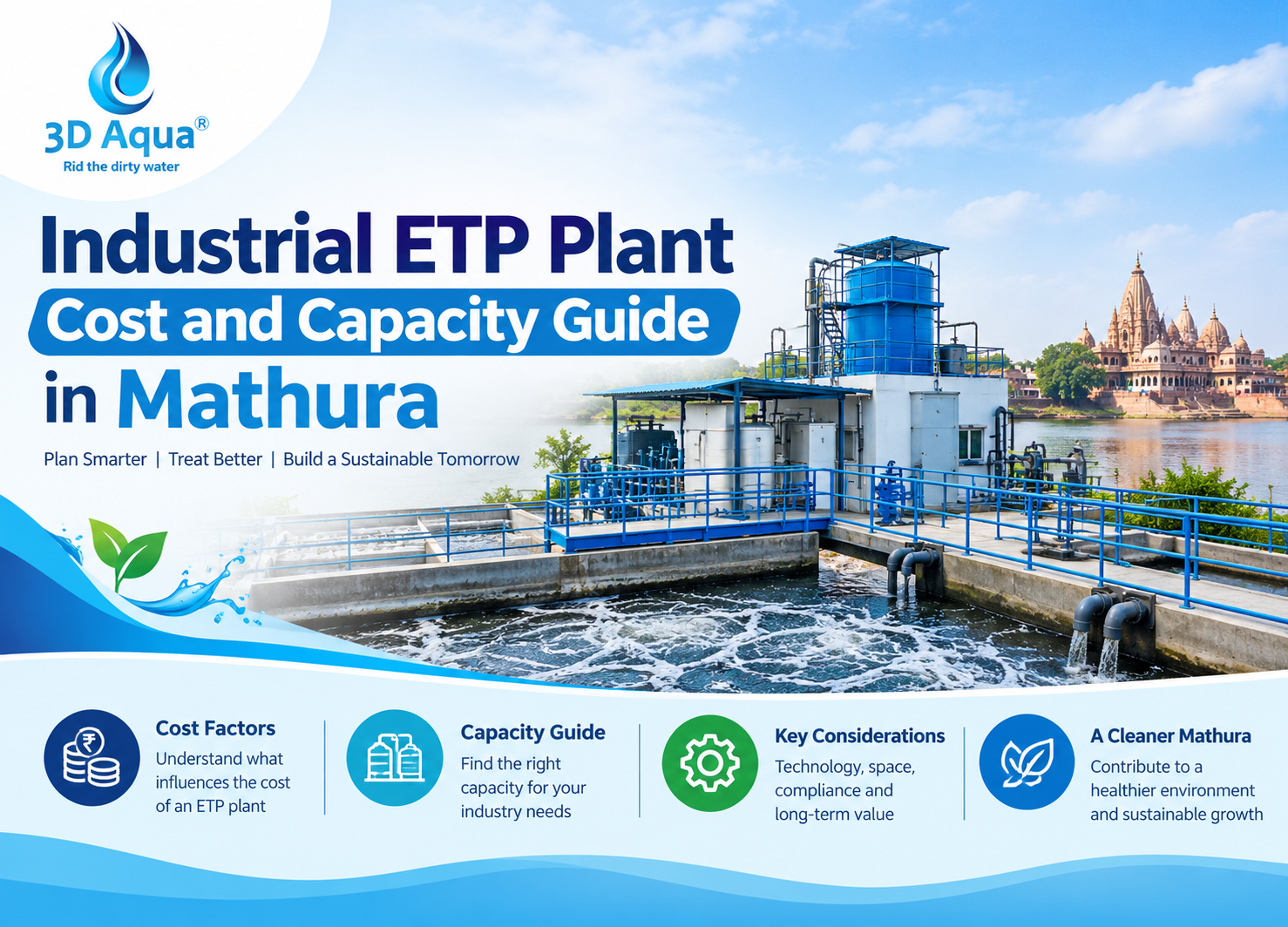
Industries in Mathura require effective wastewater treatment systems to manage industrial effluent, reduce water pollution, and meet applicable environmental regulations. Manufacturing units, food processing facilities, chemical industries, textile units, and other industrial businesses may generate wastewater containing oils, suspended solids, chemicals, and organic pollutants. Releasing untreated wastewater can create environmental risks, operational problems, and compliance issues. Installing an Industrial Effluent Treatment Plant (ETP) is an important step toward responsible wastewater management.
If you are searching for an industrial ETP plant cost and capacity guide in Mathura, understanding your wastewater characteristics, daily discharge volume, treatment requirements, and installation budget is essential. 3D Aqua provides customized water and wastewater treatment solutions designed around industrial requirements. With professional guidance, site assessment, and capacity-based system planning, industries can select a suitable ETP plant for efficient and reliable wastewater treatment.
Get FREE Water Testing & Best Price Quote in Mathura!
📞 Call / WhatsApp: 6262629090
Why Do Industries in Mathura Need an ETP Plant?
Industrial wastewater varies significantly depending on the manufacturing process, raw materials, chemicals, and cleaning activities. Without proper treatment, effluent may contain pollutants that require removal before discharge or reuse.
Industries in Mathura may face the following wastewater management challenges:
- High pollutant levels: Industrial effluent may contain suspended solids, oils, grease, organic matter, and other contaminants.
- Environmental compliance: Businesses must identify and follow the discharge standards and consent conditions applicable to their operations.
- Water wastage: Untreated wastewater cannot always be reused safely for industrial purposes.
- Operational difficulties: Poor wastewater management can lead to unpleasant odours, sludge accumulation, and drainage problems.
- Increasing operating costs: Inefficient treatment processes may increase water consumption, chemical usage, and maintenance expenses.
An appropriately designed ETP plant helps industries address these challenges through systematic wastewater treatment.
What Is an Industrial ETP Plant and How Does It Work?
An Effluent Treatment Plant is a wastewater treatment system designed to remove contaminants from industrial effluent. The treatment process depends on wastewater composition, the required outlet quality, and the intended disposal or reuse method.
A typical industrial ETP plant may include the following stages:
1. Preliminary Treatment
Screens and collection tanks remove larger solids and help manage variations in wastewater flow.
2. Oil and Grease Removal
Where required, oil separators or skimming arrangements remove floating oil and grease from the wastewater.
3. Chemical Treatment
Processes such as pH correction, coagulation, and flocculation help separate suspended particles and certain contaminants.
4. Primary Clarification
Settling tanks allow heavier particles and chemically formed sludge to separate from the wastewater.
5. Biological Treatment
Where biodegradable organic pollutants are present, biological processes such as the Activated Sludge Process (ASP) or Moving Bed Biofilm Reactor (MBBR) may be used.
6. Secondary Clarification and Filtration
Settling and filtration help remove remaining suspended solids. Additional treatment may be required depending on the application.
7. Disinfection or Advanced Treatment
Disinfection, activated carbon filtration, membrane systems, or other polishing processes may be included when required by the final water-quality targets.
The complete treatment sequence should be selected after evaluating the industrial wastewater and applicable discharge or reuse requirements.
Need an ETP plant for your industry in Mathura?
📞 Call / WhatsApp: 6262629090
Get FREE Water Testing & Best Price Quote from 3D Aqua.
Types of Industrial ETP Plants Available
Different industries require different treatment technologies. The following options may be considered depending on wastewater characteristics and project requirements.
1. Conventional ETP Plant
A conventional ETP combines physical and chemical treatment, with biological treatment where necessary. It can be suitable for several industrial applications when designed around the effluent characteristics.
2. MBBR-Based ETP Plant
A Moving Bed Biofilm Reactor uses specially designed media that support biological growth. It can provide a compact biological treatment solution for suitable wastewater applications.
3. ASP-Based ETP Plant
The Activated Sludge Process uses microorganisms to reduce biodegradable organic pollutants. It generally requires appropriate aeration, clarification, and sludge management facilities.
4. Compact ETP Plant
Compact systems integrate selected treatment stages into a smaller footprint. They may be suitable for facilities with space constraints, depending on the wastewater load.
5. ETP with Water-Recycling System
Industries seeking water reuse may require additional filtration, membrane treatment, or other polishing stages after conventional treatment. The appropriate design depends on the intended reuse application and target water quality.
Industrial ETP Plant Cost in Mathura
The cost of an industrial ETP plant in Mathura depends on its capacity, wastewater characteristics, treatment technology, automation level, civil construction, and installation requirements. Therefore, there is no single price that applies to every industrial project.
The following figures are indicative preliminary budgeting ranges, not verified quotations from 3D Aqua. Actual supplier prices may differ substantially.
| ETP Capacity | Indicative Budget Range |
|---|---|
| 5 KLD | ₹3 lakh–₹7 lakh |
| 10 KLD | ₹5 lakh–₹12 lakh |
| 25 KLD | ₹8 lakh–₹20 lakh |
| 50 KLD | ₹15 lakh–₹35 lakh |
| 100 KLD | ₹25 lakh–₹60 lakh |
| 200 KLD | ₹45 lakh–₹1 crore or more |
KLD means kilolitres per day. One KLD equals 1,000 litres per day. These broad estimates are for initial planning only; they are not guaranteed market rates. Confirm the scope and final price with a site-specific quotation.
Factors That Affect ETP Plant Cost
Plant capacity: Higher wastewater volumes generally require larger tanks, equipment, and treatment infrastructure.
Wastewater quality: Effluent containing high concentrations of chemicals, oils, solids, or difficult-to-treat pollutants may need additional treatment stages.
Technology selection: Conventional, MBBR, ASP, and advanced treatment systems have different equipment and operating requirements.
Automation: Automatic dosing, monitoring instruments, control panels, and other automation features can affect the total project cost.
Civil work and installation: Tank construction, foundations, piping, electrical work, transportation, and site conditions may influence the budget.
Sludge handling: Sludge collection, dewatering, storage, and disposal arrangements may add to capital and operating costs.
For an accurate ETP plant price in Mathura, request a quotation based on wastewater testing, required capacity, and the complete project scope.
How to Select the Right ETP Plant Capacity
ETP capacity is usually expressed in KLD and should be based on the actual daily wastewater generation rather than total water consumption alone.
For example:
- 5–10 KLD: May suit small industrial units with relatively low wastewater generation.
- 25–50 KLD: May suit medium-sized operations with moderate effluent volumes.
- 100 KLD and above: May be suitable for larger facilities generating substantial wastewater.
These are general planning examples, not fixed classifications. Two industries generating the same wastewater volume may require different treatment systems because their effluent composition and pollution loads differ.
Before selecting a plant, consider daily wastewater generation, peak flow, operating hours, pollutant concentrations, future expansion, and the required treated-water quality. A qualified technical assessment helps determine the appropriate capacity and process design.
Why Choose 3D Aqua for Industrial ETP Plants in Mathura?
3D Aqua provides water and wastewater treatment solutions for industrial and commercial applications. Selecting the right system requires more than comparing equipment prices; the design must also meet the facility’s treatment objectives and operating conditions.
Site Inspection Before Quotation
A site inspection helps evaluate available space, wastewater collection arrangements, installation conditions, and project-specific requirements before preparing a quotation.
Customized Capacity-Based Solutions
Each industrial unit has different wastewater volumes and pollutant characteristics. Treatment systems should be planned according to the required capacity, wastewater analysis, and applicable treatment standards.
After-Sales Support and Maintenance
Routine maintenance helps maintain treatment efficiency and equipment reliability. Depending on the agreed service scope, support may include equipment checks, process troubleshooting, and maintenance guidance.
Industrial Water Treatment Expertise
3D Aqua offers water treatment solutions covering ETP, STP, RO, UF, WTP, and water softening applications.
Contact 3D Aqua today for industrial ETP plant consultation in Mathura.
📞 Call / WhatsApp: 6262629090
Frequently Asked Questions (FAQs)
1. What is the cost of an industrial ETP plant in Mathura?
The cost depends on capacity, wastewater quality, treatment technology, civil work, and installation requirements. Small systems may require a budget of several lakh rupees, while larger or more complex projects can cost considerably more. A site-specific quotation is recommended.
2. Which ETP capacity is suitable for my industry?
The right capacity depends on daily wastewater generation, peak flow, operating hours, and future expansion. Wastewater testing and a technical assessment help determine the appropriate plant size.
3. Which industries need an ETP plant?
Industries generating wastewater that requires treatment may need an ETP. Examples include food processing, textiles, chemicals, manufacturing, pharmaceuticals, and other industrial operations, subject to their specific wastewater and regulatory requirements.
4. How long does it take to install an industrial ETP plant?
Installation time depends on plant capacity, design complexity, equipment availability, civil construction, and site readiness. A compact packaged plant may take less time than a large customised project. The supplier should confirm the project schedule after reviewing the site.
5. Can treated ETP water be reused?
Yes, treated effluent may be reused for suitable applications if it meets the relevant water-quality requirements. Additional filtration, disinfection, or membrane treatment may be necessary depending on the intended use.
Still confused?
📞 Call / WhatsApp: 6262629090 for expert guidance from 3D Aqua.
Get the Best Industrial ETP Plant in Mathura
Facing industrial wastewater treatment challenges? Don’t wait until inefficient treatment affects your operations or creates compliance concerns. Choose an ETP solution designed around your wastewater characteristics, daily capacity, and treatment requirements.
Contact 3D Aqua today for your industrial ETP plant requirements in Mathura.
📞 Call / WhatsApp: 6262629090
🌐 Website: https://www.3daqua.in/
👇 Fill out the enquiry form for:
- Free consultation
- Best price quotation
- Site inspection
Contact Details – 3D Aqua
Manufacturing & Support:
- Okhla Industrial Area, Delhi
- Sector 10, Noida, Uttar Pradesh
Contact Us:
0120-4153030 | 7011143366 | 6262629090
24/7 Helpline: +91 8963089630
Email: info@3daqua.in
Learn More:
- Website: https://www.3daqua.in/
- Products: https://www.3daqua.in/products
- Happy Clients: https://3daqua.in/clients
Choose a suitable industrial ETP plant with professional guidance from 3D Aqua and take a practical step toward responsible wastewater management in Mathura.