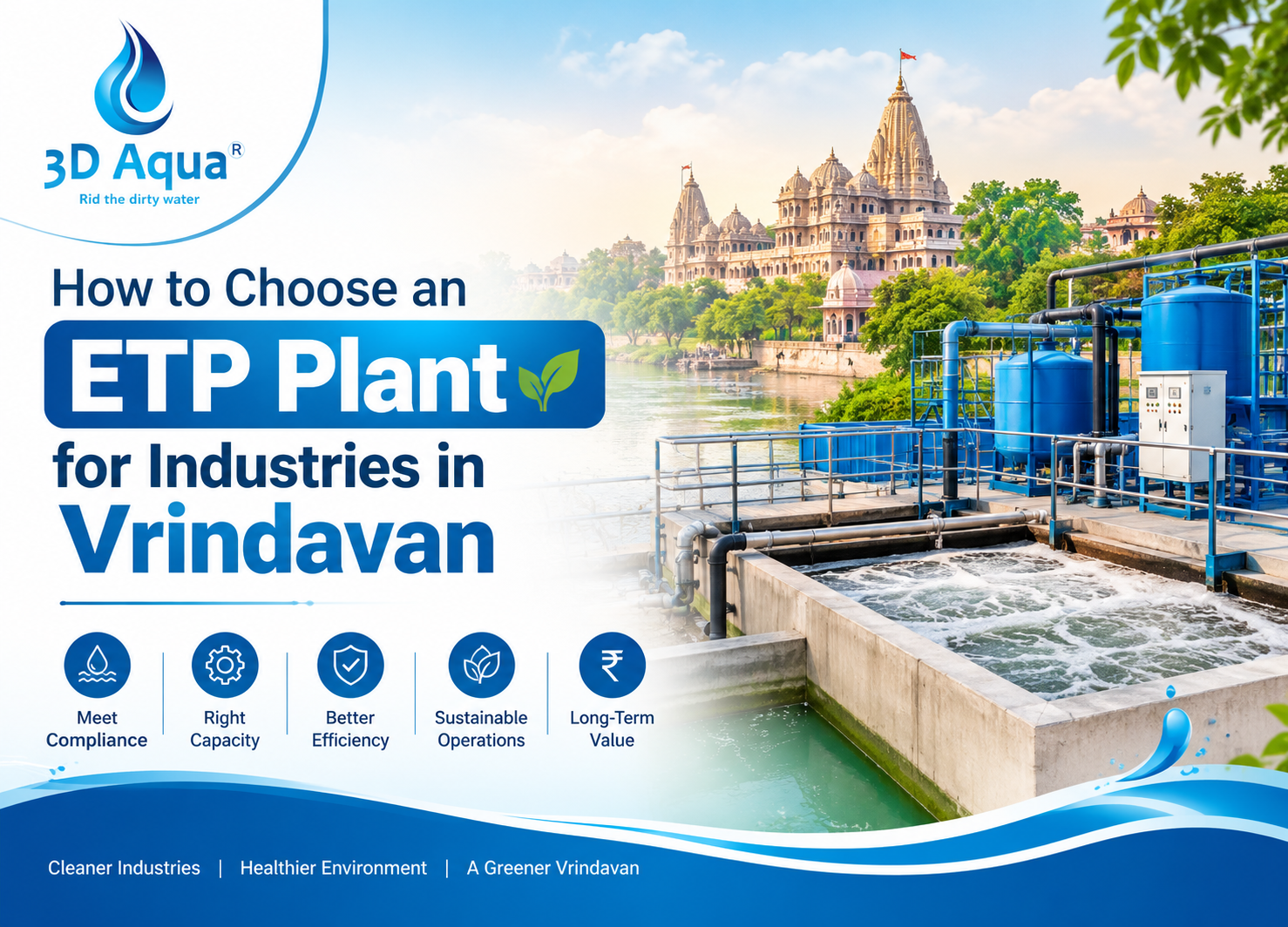
Industries in Vrindavan generate wastewater from manufacturing processes, equipment cleaning, chemical use, and daily industrial operations. If this wastewater is discharged without proper treatment, it can cause environmental pollution, damage water resources, and create compliance issues for businesses. Choosing the right Effluent Treatment Plant (ETP) in Vrindavan is essential for industries that want to manage wastewater efficiently, maintain hygiene, and follow applicable pollution control regulations.
However, selecting an ETP plant requires careful consideration of wastewater characteristics, treatment capacity, industry type, installation space, and operating costs. 3D Aqua provides customized water and wastewater treatment solutions designed to meet different industrial requirements. From site inspection and system design to installation and after-sales support, our team helps businesses identify suitable ETP solutions for their operations.
If you are planning to install a new ETP plant or upgrade an existing wastewater treatment system in Vrindavan, choosing the right technology can improve treatment performance and long-term operational efficiency.
Get an ETP Plant Consultation in Vrindavan
Call / WhatsApp: 6262629090
Get FREE Water Testing & Best Price Quote in Vrindavan.
Why Do Industries in Vrindavan Need an ETP Plant?
Industrial wastewater may contain suspended solids, oils, grease, organic matter, chemicals, detergents, and other contaminants. The type and concentration of pollutants depend on the industrial process. Without suitable treatment, wastewater can negatively affect the environment and create operational and regulatory challenges.
Industries in Vrindavan and nearby industrial areas should evaluate their wastewater management requirements before selecting a treatment system.
Common wastewater management challenges include:
- High pollution levels: Untreated industrial effluent may contain contaminants that require specialized treatment.
- Changing wastewater quality: Production schedules and raw materials can cause variations in wastewater characteristics.
- Regulatory compliance: Industries must identify and meet the discharge or reuse requirements applicable to their operations.
- Water wastage: Inadequately treated wastewater may not be suitable for reuse in appropriate industrial applications.
- Equipment and maintenance issues: Incorrectly designed treatment systems can experience poor performance, frequent breakdowns, and higher operating costs.
An appropriately designed ETP plant helps industries manage these challenges through a treatment process selected according to their specific wastewater characteristics.
How to Choose the Right ETP Plant for Your Industry in Vrindavan
Selecting an ETP plant involves more than comparing equipment prices. The system should match your industrial wastewater profile, daily effluent volume, available space, and treatment objectives.
1. Identify Your Industry Type
Start by identifying the type of wastewater your industry generates. Different industries require different treatment processes.
For example:
- Food processing units: May generate wastewater containing organic matter, fats, oils, and grease.
- Textile and dyeing units: May require treatment for colour, suspended solids, and process chemicals.
- Pharmaceutical and chemical industries: May need specialized treatment based on the chemical composition and toxicity of the effluent.
- Engineering and manufacturing units: May generate wastewater containing oils, metals, or other process-specific contaminants.
- Hotels and commercial facilities: May require a wastewater treatment solution depending on the source and characteristics of the effluent.
A professional assessment helps determine the appropriate treatment stages for your application.
2. Calculate the Required Treatment Capacity
ETP capacity is generally expressed in kilolitres per day (KLD). Selecting the correct capacity is essential for effective treatment.
Estimate the average daily wastewater generation, peak flow, operating hours, and possible future production increases. A system with insufficient capacity may struggle during peak operations, while an oversized plant may increase capital and operating expenses unnecessarily.
For example, an industry generating approximately 50 KLD of wastewater may consider a 50 KLD system as an initial reference point. However, the final design should account for peak flows, wastewater characteristics, and the treatment process rather than relying on average flow alone.
3. Test the Wastewater Before Selecting Technology
Wastewater testing helps establish the treatment requirements. Depending on the industry, important parameters may include:
- pH level
- Biological Oxygen Demand (BOD)
- Chemical Oxygen Demand (COD)
- Total Suspended Solids (TSS)
- Oil and grease
- Total Dissolved Solids (TDS), where relevant
- Industry-specific chemicals or contaminants
The test results help engineers select suitable treatment processes and estimate the equipment required.
Tip: Avoid purchasing an ETP plant based only on wastewater volume. Two industries producing the same quantity of effluent may require very different treatment technologies.
4. Check Available Installation Space
The selected ETP must fit within the available site without interfering with production or access for maintenance. Consider the space needed for treatment tanks, pumps, filtration units, chemical dosing systems, sludge handling, electrical panels, and operator movement.
Where space is limited, a compact or modular ETP design may be suitable, depending on the wastewater characteristics and required treatment performance.
5. Evaluate Operating and Maintenance Costs
The initial purchase price is only one part of the total cost. Industries should also consider electricity consumption, chemical usage, sludge disposal, replacement media, spare parts, labour, and preventive maintenance.
Compare systems based on their expected lifetime operating costs, not just the lowest installation quotation.
6. Verify Compliance and Treated Water Quality
Before selecting an ETP, identify whether the treated water will be discharged, reused, or sent for further treatment. The required quality depends on the applicable consent conditions, discharge destination, and intended reuse.
A qualified supplier should explain the proposed treatment stages, expected performance, monitoring requirements, and any additional polishing or disinfection needed.
Types of ETP Plants Available for Industries
The most suitable ETP technology depends on the effluent composition, treatment objectives, land availability, and operating requirements.
1. Physico-Chemical ETP
This system uses processes such as chemical dosing, coagulation, flocculation, and clarification to remove suspended particles, certain dissolved contaminants, and other pollutants that respond to chemical treatment.
It is commonly considered for wastewater containing suspended solids, colour, or specific chemical contaminants.
2. Biological ETP
Biological treatment uses microorganisms to break down biodegradable organic pollutants. Aerobic or anaerobic processes may be selected according to the wastewater characteristics and treatment objectives.
This option can be useful when wastewater contains biodegradable organic matter requiring BOD and COD reduction.
3. Combined Physico-Chemical and Biological ETP
Some industries require a combination of chemical and biological treatment. Additional filtration or other polishing stages may be included to achieve the desired treated water quality.
The exact configuration depends on laboratory results and the applicable treatment requirements.
4. Compact or Modular ETP
Compact ETP systems combine selected treatment stages within a space-efficient arrangement. Modular designs may be suitable for facilities with limited installation space or changing capacity requirements.
Their suitability must be confirmed through engineering assessment.
5. ETP with Advanced Treatment or Reuse Systems
Where higher-quality treated water is required, an ETP may be integrated with filtration, activated carbon, membrane systems, or reverse osmosis, where appropriate.
These additional processes should be selected according to the intended reuse application, dissolved contaminants, recovery requirements, and concentrate disposal arrangements.
Find the Right ETP Solution for Your Industry
Need an industrial wastewater treatment system in Vrindavan? 3D Aqua can help you evaluate your requirements and identify a suitable solution.
Call / WhatsApp: 6262629090
Get FREE Water Testing & Best Price Quote.
ETP Plant Price in Vrindavan
The cost of an ETP plant depends on treatment capacity, wastewater composition, technology, automation, construction requirements, and installation conditions. Therefore, the following figures are only broad preliminary budgeting estimates, not a quotation from 3D Aqua.
| ETP capacity | Indicative budget range |
|---|---|
| 5–10 KLD | ₹3 lakh–₹8 lakh |
| 10–25 KLD | ₹5 lakh–₹15 lakh |
| 25–50 KLD | ₹10 lakh–₹25 lakh |
| 50–100 KLD | ₹18 lakh–₹45 lakh |
| 100–250 KLD | ₹35 lakh–₹90 lakh |
| Above 250 KLD | Site-specific quotation |
Note: Actual prices may differ substantially. These illustrative ranges are not verified current market quotations and may exclude civil construction, GST, piping, electrical work, advanced treatment, sludge handling, and commissioning. Confirm the complete scope with the supplier before budgeting.
For an accurate ETP plant price in Vrindavan, arrange wastewater testing and a site assessment. A detailed quotation should specify capacity, treatment technology, equipment, installation scope, performance expectations, and maintenance requirements.
Why Choose 3D Aqua for an ETP Plant in Vrindavan?
Choosing an experienced water treatment partner can help simplify plant selection, installation, and long-term operation.
Site Inspection Before Quotation
3D Aqua can assess the available installation area, wastewater generation, site conditions, and project requirements before recommending a suitable system. Site inspection helps develop a more realistic project scope and quotation.
Customized Capacity-Based Solutions
Every industry has different wastewater characteristics and production requirements. Treatment capacity and technology should be selected according to wastewater testing, daily flow, peak loads, and the required treated water quality.
3D Aqua offers water and wastewater treatment solutions tailored to project requirements rather than relying on a single design for every application.
After-Sales Support and Maintenance
Routine maintenance is important for consistent treatment performance. Depending on the agreed service scope, support may include equipment checks, preventive maintenance, troubleshooting, and guidance on operating procedures.
Complete Water Treatment Expertise
In addition to ETP solutions, 3D Aqua works with water treatment applications such as STP, WTP, RO plants, UF systems, and water softeners. This broader experience can be helpful when a project requires multiple treatment stages.
Manufacturing & Support Locations:
- Okhla Industrial Area, Delhi
- Sector 10, Noida, Uttar Pradesh
For project-specific availability and service arrangements in Vrindavan, contact the team directly.
Frequently Asked Questions (FAQs)
1. What is an ETP plant?
An Effluent Treatment Plant is a system designed to treat industrial wastewater by removing or reducing contaminants before discharge or reuse, according to the applicable requirements.
2. How do I choose the correct ETP capacity for my industry?
Calculate daily and peak wastewater generation, test the effluent, and assess future production needs. A treatment engineer can recommend the capacity and process configuration based on these findings.
3. What is the cost of an ETP plant in Vrindavan?
The cost varies according to capacity, wastewater composition, technology, automation, and installation requirements. A site assessment and wastewater analysis help establish a more accurate project quotation.
4. Can treated ETP water be reused?
Yes, treated wastewater may be suitable for certain applications if it meets the required quality standards. Additional filtration, disinfection, or membrane treatment may be necessary depending on the intended use.
5. How often does an ETP plant require maintenance?
Maintenance frequency depends on the treatment technology, wastewater load, operating conditions, and equipment manufacturer’s recommendations. Regular inspections, cleaning, monitoring, and preventive maintenance help support reliable operation.
Still confused about selecting an ETP plant?
Call / WhatsApp 6262629090 for expert guidance.
Get the Best ETP Plant Solution in Vrindavan
Facing industrial wastewater treatment challenges? Don’t wait until they affect your operations. Choose a suitable ETP plant with professional guidance from 3D Aqua.
Call / WhatsApp: 6262629090
Website: https://www.3daqua.in/
Fill out the enquiry form for:
- Free consultation
- Best price quotation
- Site inspection
Contact Details – 3D Aqua
Manufacturing & Support:
- Okhla Industrial Area, Delhi
- Sector 10, Noida, Uttar Pradesh
Contact Us: 0120-4153030 | 7011143366 | 6262629090
24/7 Helpline: +91 8963089630
Email: info@3daqua.in
Website: https://www.3daqua.in/
Explore Softener Products: https://www.3daqua.in/products
Happy Clients: https://3daqua.in/clients
Partner with 3D Aqua to explore a customized industrial wastewater treatment solution for your facility in Vrindavan.