
Managing wastewater is one of the biggest challenges for residential societies, industries, hotels, and commercial complexes in cities like Delhi, Noida, and across India. Untreated sewage not only pollutes the environment but also leads to serious legal penalties and health risks. That’s where a Sewage Treatment Plant (STP) becomes essential. Understanding the STP plant working principle helps businesses and property owners make informed decisions about water treatment and reuse.
At 3D Aqua, we provide advanced, reliable, and cost-effective STP solutions designed to meet pollution control norms and ensure sustainable water management. With years of expertise and trusted installations, we help you convert wastewater into reusable water efficiently.
Call / WhatsApp: 6262629090
Get FREE Water Testing & Best Price Quote in Delhi, Noida & Nearby Areas
Problem Section: Why Wastewater Treatment is Crucial
- Domestic wastewater (toilets, kitchens, bathrooms)
- Industrial effluents (chemicals, oils, contaminants)
- Commercial waste (hotels, malls, hospitals)
Without proper treatment, this wastewater causes:
- Environmental pollution of rivers and groundwater
- Spread of diseases and harmful bacteria
- Legal issues due to non-compliance with pollution norms
- Water scarcity due to lack of reuse
Government bodies like CPCB mandate wastewater treatment before discharge or reuse. This makes installing an STP plant not just important—but mandatory.
Solution Section: STP Plant Working Principle Explained
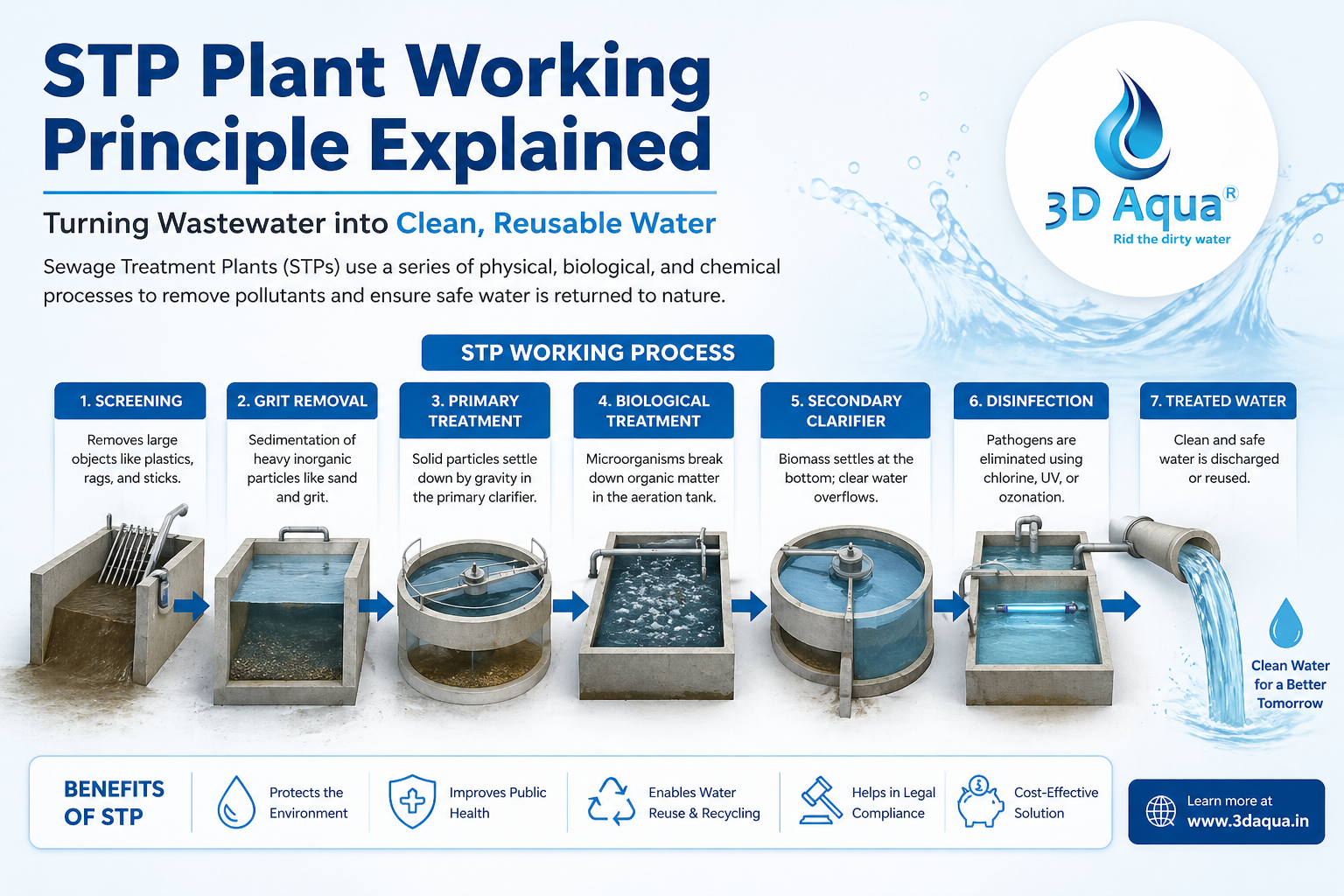
A Sewage Treatment Plant (STP) works on a systematic process to remove contaminants from wastewater and make it safe for reuse or discharge. The working principle involves physical, biological, and chemical processes.
1. Preliminary Treatment
The first stage removes large solid particles like plastics, stones, and debris using screens and grit chambers. This prevents damage to equipment.
2. Primary Treatment
In this stage, wastewater is stored in sedimentation tanks where heavy solids settle at the bottom (sludge), and lighter materials float on top.
3. Biological Treatment (Core Process)
This is the heart of the STP plant working principle. Microorganisms break down organic matter in wastewater. Common technologies include:
- Activated Sludge Process (ASP)
- Moving Bed Biofilm Reactor (MBBR)
- Sequential Batch Reactor (SBR)
These bacteria consume harmful pollutants and convert them into harmless by-products.
4. Secondary Clarification
After biological treatment, water is sent to a clarifier where remaining solids settle down, and clear water is separated.
5. Tertiary Treatment
Advanced filtration and disinfection processes such as UV, chlorination, or sand filtration are used to remove remaining impurities.
6. Water Reuse
Treated water can be reused for:
- Gardening
- Flushing
- Cooling towers
- Industrial processes
Call / WhatsApp: 6262629090
Get FREE Water Testing & Best Price Quote
Types / Options of STP Plants
Different technologies are used depending on capacity, space, and application:
1. MBBR (Moving Bed Biofilm Reactor)
- Compact design
- Low maintenance
- High efficiency
2. SBR (Sequential Batch Reactor)
- Ideal for space-saving
- Automated operation
- High-quality output
3. ASP (Activated Sludge Process)
- Traditional and widely used
- Suitable for large-scale plants
4. MBRT (Membrane Bioreactor Technology)
- Advanced filtration
- Produces ultra-clean water
- Higher cost but best performance
5. Packaged STP Plants
- Ready-to-install units
- Best for small spaces and quick deployment
STP Plant Price (Approximate Cost)
| Capacity (KLD) | Price Range (INR) |
|---|---|
| 10–25 KLD | ₹1.5 – ₹5 Lakhs |
| 50 KLD | ₹5 – ₹10 Lakhs |
| 100 KLD | ₹10 – ₹18 Lakhs |
| 200+ KLD | ₹18 – ₹50+ Lakhs |
Note: Prices vary based on technology, automation level, and customization.
Why Choose 3D Aqua?
When it comes to reliable STP solutions in Delhi, Noida, and across India, 3D Aqua stands out due to:
- ✔ Site inspection before quotation
- ✔ Customized capacity-based solutions
- ✔ Advanced and energy-efficient technology
- ✔ Compliance with pollution control norms
- ✔ Complete installation and commissioning
- ✔ After-sales support & maintenance services
- ✔ Experienced engineering team
We ensure that your wastewater treatment system runs smoothly with maximum efficiency and minimum operational cost.
FAQ (Frequently Asked Questions)
1. What is the main purpose of an STP plant?
The main purpose is to treat sewage water and make it safe for reuse or discharge into the environment.
2. How does an STP plant work?
It works through multiple stages including screening, sedimentation, biological treatment, and filtration to remove contaminants.
3. Is treated water safe to reuse?
Yes, treated water can be reused for non-drinking purposes like gardening, flushing, and cooling systems.
4. What is the maintenance requirement for an STP plant?
Regular sludge removal, equipment checks, and periodic servicing ensure efficient operation.
5. Which STP technology is best?
It depends on your requirement. MBBR and SBR are commonly preferred for modern installations.
Still confused?
📞 Call / WhatsApp: 6262629090 for expert guidance.
Get the Best STP Plant in Delhi, Noida & Nearby Areas
Facing wastewater management issues? Don’t wait.
📞 Call / WhatsApp: 6262629090
🌐 Visit: www.3daqua.in
👇 Fill the enquiry form below for:
✔ Free consultation
✔ Best price
✔ Site inspection
Contact Details – 3D Aqua
Manufacturing & Support:
Okhla Industrial Area, Delhi
Sector 10, Noida, Uttar Pradesh
Contact Us:
0120-4153030 | 7011143366 | 6262629090
24/7 Helpline: +91 8963089630
Email: info@3daqua.in
Learn More:
Website: www.3daqua.in
Explore Softener Products: www.3daqua.in/products
Happy Clients: https://3daqua.in/clients